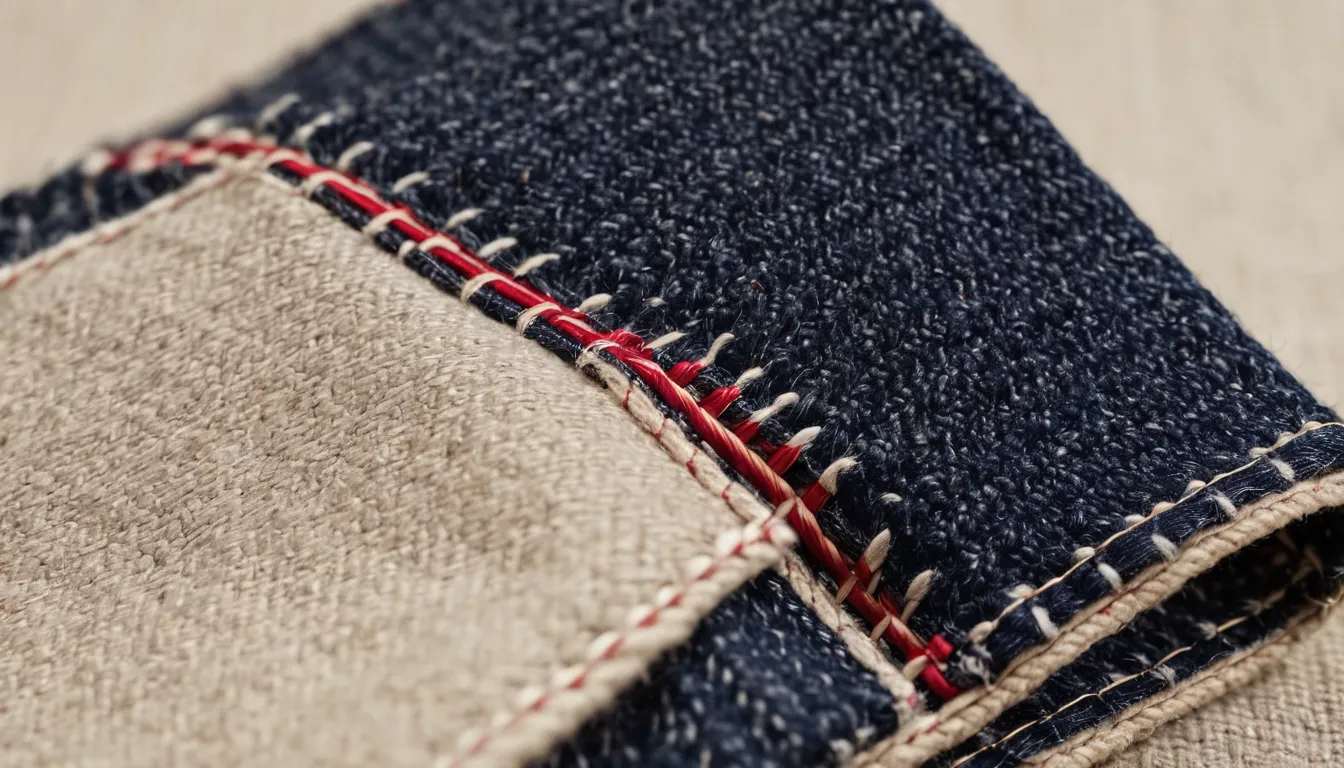
A twill weave
Denim is a twill, a weave where the yarns cross in a stepped pattern that forms diagonal lines on the surface. In most denim, each lengthwise yarn (the warp) passes over three crosswise yarns (the weft) and then under one. That is called a three-by-one twill. Because the warp yarns show more on the front, the front takes on their color.
The direction of the diagonal also has names. Right-hand twill, with lines running up to the right, is the most common. Left-hand twill runs the other way and is often described as softer to the touch. Broken twill reverses the direction every few yarns, which helps stop the legs of a pair from twisting around after washing.
Indigo and fading
Classic blue denim uses indigo-dyed warp yarns and an undyed weft. That is why the inside of your jeans is pale. Indigo builds up on the outside of the yarn in thin layers and leaves the core light. As the surface wears, the core shows through, creating fades at the knees, thighs, pockets and hems.
Indigo also rubs off onto other things, especially when the denim is new and dark. Light sofas, white sneakers and pale bags can pick up a blue tint. That transfer is called crocking. It fades over time, and the washing guide covers how to limit it.
Selvedge and wide-loom denim
Selvedge (sometimes spelled selvage) denim is woven on older shuttle looms that make a narrow fabric with a neat, self-finished edge. That edge does not fray, so it is often used along the outseam. When you roll up the cuff, you see a clean band, sometimes with a colored line in the weave. The colored line was a way for mills to tell fabrics apart.
Most denim today is woven on wider, faster projectile or air-jet looms. The edges are cut and finished with an overlock stitch. Wide-loom denim is not lower quality by default. Fabric quality depends on the cotton, the yarn and the dyeing far more than on the loom. Selvedge does tend to cost more, because the looms are slower and the fabric is narrower.
Raw and washed denim
Raw denim (also called dry denim) has not been washed after dyeing. It starts stiff and dark and changes shape with wear, so the fades follow how you sit and move. Washed denim has been rinsed, softened or treated at the factory, which makes it comfortable from day one and keeps it from changing much.
Some raw denim is sanforized, meaning it went through a pre-shrinking process at the mill. Sanforized raw denim still shrinks a little in the first wash, usually only a few percent. Unsanforized raw denim (sometimes called shrink-to-fit) can shrink much more, often several percent in length and some in the waist. If you buy unsanforized jeans, read the maker's sizing advice before choosing a size.
Stretch denim and blends
Many jeans today mix cotton with a small amount of elastane (spandex), usually a few percent. That gives stretch and recovery, so the jeans move with you and spring back. More elastane means more stretch, but stretch fibers break down with heat over time. That is one reason to avoid hot washes and the dryer.
You may also see cotton blended with polyester, which can add strength and reduce shrinkage, or with lyocell and other cellulose fibers, which make denim softer and more drapey. The fiber content is on the care label inside the jeans.
Black, gray and colored denim
Black denim is usually dyed with sulfur dyes instead of indigo. It fades too, but toward gray rather than toward pale blue. Some black denim has a black weft as well, so it looks black inside and fades more slowly. Colored and white denim use other dyes and often fade differently from indigo.
Reading a fabric description
| Term | What it tells you |
|---|---|
| Weight in ounces | How heavy the fabric is per square yard. See denim weights. |
| Selvedge | Woven on a shuttle loom, with a finished edge along the outseam |
| Raw or dry | Not washed after dyeing. Stiff and dark at first |
| Sanforized | Pre-shrunk at the mill. Expect only small shrinkage |
| Unsanforized or shrink-to-fit | Not pre-shrunk. Expect real shrinkage in the first wash |
| Rigid | Little or no stretch fiber |
| Comfort stretch or high stretch | Contains elastane or a similar stretch fiber |